
Hancock County Criminal Court Cases
The Hancock County court in the Ninth Judicial Circuit is the local Illinois trial court. It hears both felony and misdemeanor cases. Traffic and fine-only ordinance matters may also enter the same circuit system. A city police department can make an arrest, but the prosecution is filed as the People of the State of Illinois. Hancock County does not have a separate constitutional municipal criminal court with its own public docket.
The Circuit Clerk keeps the court file at 500 Main Street in Carthage. That file begins when a complaint, information, or indictment is filed. The clerk records the case number, schedule, orders, financial entries, and disposition. Court Services in Suite 3A handles pretrial and probation work, but its private supervision notes are not part of the open court file merely because a sentence appears on the docket.
Hancock County's Single Court Path
The single trial-court structure makes the first routing choice clear. Take filed criminal-case questions to the Hancock County Circuit Clerk, not to a city hall or the sheriff. The official Circuit Clerk page links court services, payments, copies, and Judici. It also identifies the office that can confirm whether an older file is available before a trip to Carthage.
The courthouse has a second-floor e-filing workstation and electronic recording, according to the Ninth Circuit. Those tools do not mean every case document can be downloaded. Public terminals, clerk-held paper files, and online docket summaries may expose different layers. The clerk can explain which layer holds a document and whether certification is offered.
The county's Circuit Clerk page shows the local court-services route and office context.
View the Hancock County Circuit Clerk source before choosing an access method.
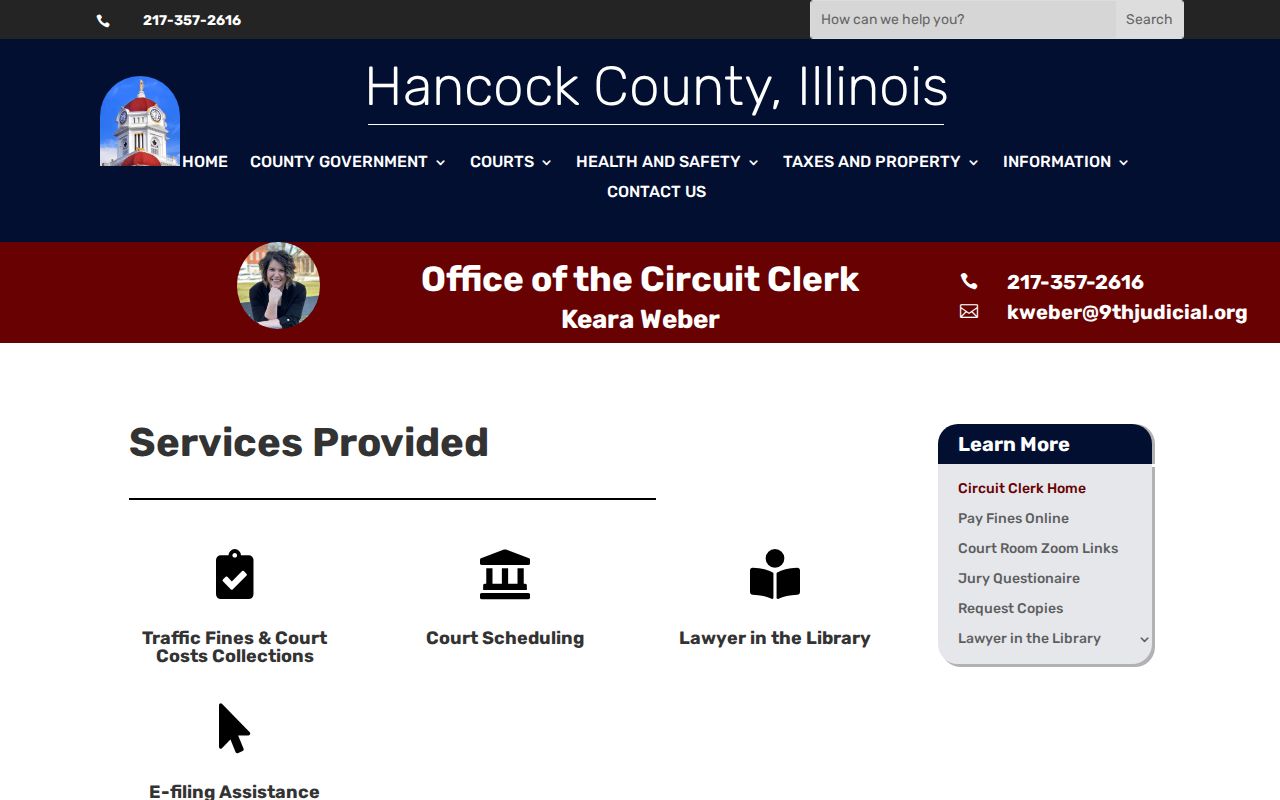
The captured page helps distinguish local clerk services from the separate arrest and jail records held on Buchanan Street.
Searching Hancock County Case Records
Hancock County links readers to Judici, a privately operated service for participating Illinois counties. It is not an AOIC-owned, complete statewide trial-court database. Select Hancock County before entering a name. A case number is the strongest key. If only a name is known, use the date and case category to avoid confusing people who share a name.
- Open Judici and select Hancock County from the participating-county list.
- Search by case number when known, or enter the party's first and last name.
- Narrow the results by category, filing period, and other controls the live form offers.
- Open the matching docket, then compare every charge, event, hearing, and financial panel.
- Ask the Circuit Clerk for an unavailable image, older record, or certified copy.
The searchable fields and record panels serve different jobs. Search inputs locate a candidate case; the docket and charge rows show what happened after filing.
| Search field | Type | Required | Use |
|---|---|---|---|
| County | Selection | Yes | Choose Hancock |
| Case number | Text | No | Best exact match |
| Last name | Text | For name search | Party surname |
| First name | Text | No | Narrows name matches |
| Category or date | Filter | No | Limits broad results |
The Judici interface shows why county selection and case-level review matter.
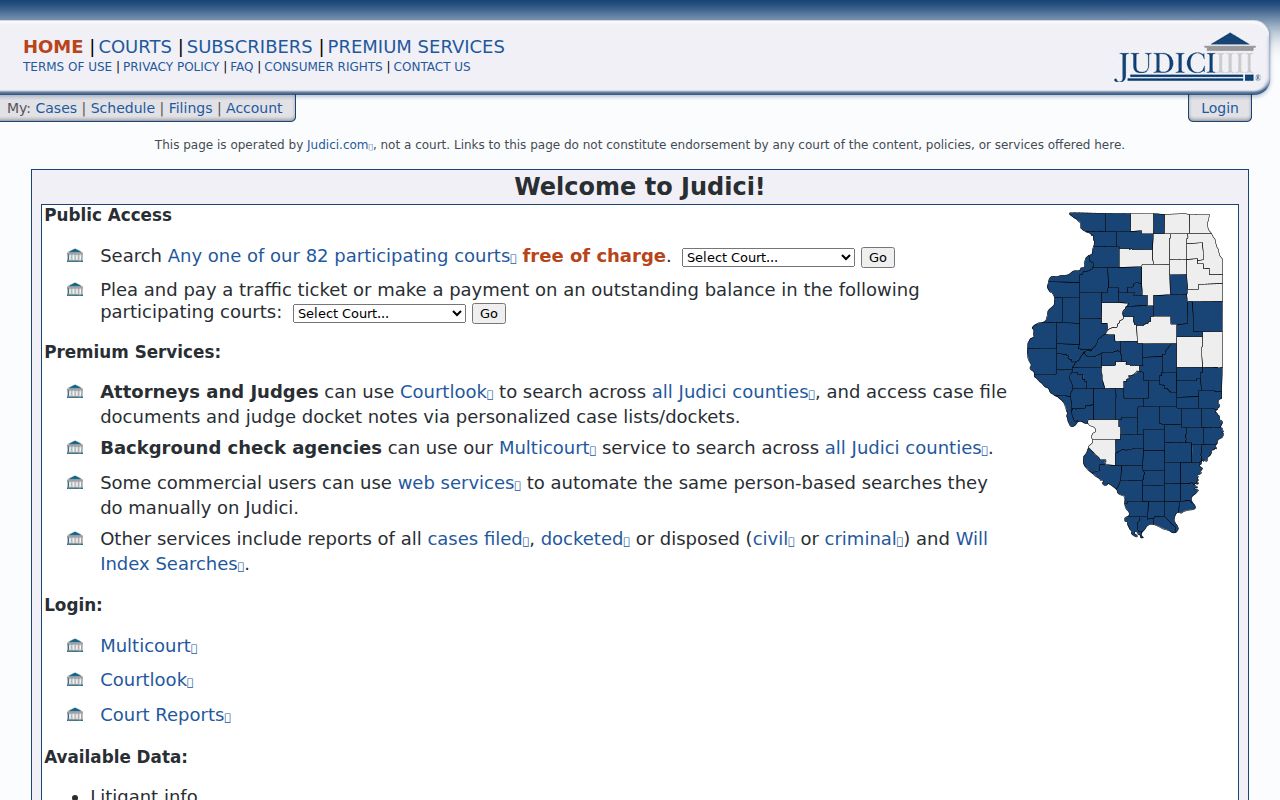
A result is a lead to the docket. It is not a substitute for a clerk-certified copy.
Reading Hancock County Case Codes
Illinois case codes help sort records before the facts are read. A CF case is a felony filing. A CM case is a criminal misdemeanor. Traffic and ordinance labels can also appear in the circuit system. The code describes the docket category, not the final outcome. A felony-filed charge can be amended, dismissed, or resolved on another count.
- Arraignment
- The hearing at which the charge is stated and a plea is entered.
- Disposition
- The result for a charge, such as dismissal, acquittal, or a finding of guilt.
- Docket entry
- A dated court entry that records a filing, hearing, order, or other event.
- Certified copy
- A clerk-authenticated court document, distinct from an online screen print.
Read the charge number, statute, description, class, plea, finding, and disposition date together. “Disposed” only means that a court resolved the matter. It does not, by itself, mean conviction.
Inside a Hancock County Case File
A Hancock County court file can hold far more than a single status label. The useful fields connect the filed accusation to each later act of the court. Some entries are only indexes. Protected identifiers, sealed material, confidential reports, and victim or minor information may be omitted or redacted.
| Case and caption | Case number, court, parties, filing date, type, status, and judge. |
|---|---|
| Charging record | Charge number, citation, description, class, offense date, and arresting agency when supplied. |
| Docket entries | A dated history of filings, hearings, motions, and orders. |
| Release record | First-appearance action, detention ruling, and release conditions. |
| Disposition | Plea, finding, charge-level outcome, judgment, and disposition date. |
| Sentence | Custody or probation term, conditions, fines, costs, balance, and later court events. |
The online view may link some images while withholding others. If the docket lists a document but provides no image, identify the case number, filing title, and date when contacting the clerk.
Getting Hancock County Court Copies
Call the Circuit Clerk at 217-357-2616 before seeking archived material or making a records trip. The office is at the Hancock County Courthouse, 500 Main Street, Carthage, IL 62321, and its FOIA mailing address is P.O. Box 189. Courthouse hours are Monday through Friday, 8:00 a.m. to 4:00 p.m. The research does not publish a local copy or certification fee, so confirm the current cost and delivery method with the clerk.
Hancock County Circuit Clerk
500 Main Street
P.O. Box 189
Carthage, IL 62321
217-357-2616
Monday-Friday, 8:00 a.m.-4:00 p.m.
The county copy-request channel is the source for current instructions. State the case number and exact document when possible. Ask whether a plain copy, certified copy, or inspection is needed, since those are distinct products.
How a Criminal Case Moves
A Hancock County case may start with an arrest or summons. The prosecutor then files a complaint or information, or seeks a grand-jury indictment. At arraignment, the defendant hears the filed charge and enters a plea. Discovery and pretrial motions follow. A negotiated plea or trial leads to judgment, and a guilty finding may lead to sentencing and later post-judgment action.
Case flow: Charges Filed › Arraignment › Pretrial › Plea or Trial › Disposition › Sentencing
Since September 2023, Illinois pretrial decisions use the Pretrial Fairness Act framework. Courts decide release conditions and may order detention after a qualifying petition and proof. Older Hancock County dockets can still contain “bond” entries, so the date and order text matter. A booking allegation may also differ from the charge that the prosecutor ultimately filed.
Hancock County Dispositions Reach ISP
The court result does not stay only in Carthage. Courts and prosecutors report eligible dispositions to the Illinois State Police Bureau of Identification, where the result is matched to the arrest fingerprint cycle. A lag, identifier error, or missing disposition can create a gap between the court docket and the state history response.
If your own Illinois transcript is wrong or incomplete, use ISP Access and Review and its Record Challenge process. The court file can supply the disposition needed to support a correction. ISP charges no processing fee for Access and Review, though a fingerprint provider may charge.
Approved statewide forms also matter when a record qualifies for relief.
Illinois Courts publishes approved expungement and sealing forms for filing in circuit court.
A sealing or expungement order must move through the official process; an empty web result alone proves no such order exists.
Hancock County Pretrial Case Records
Release and detention entries deserve a date-aware reading. Under Illinois' current framework, the court reviews release conditions and may detain a person only through the applicable petition and proof process. Older Hancock County files may still show cash-bond language from the law then in effect. Read the order, its date, and the next hearing entry instead of treating an old “bond” label as current advice.
Pretrial information can be split across the open court docket and restricted Court Services material. The docket may show the first appearance, petitions, hearings, conditions, and judicial orders. Court Services in courthouse Suite 3A manages local pretrial and probation work, but assessment details and officer notes are not made public just because a case number is public. The clerk is the source for filed orders; Court Services can address only what that office may lawfully confirm.
Case Record Access & Restrictions
Illinois court records are generally open, but public access has limits. Juvenile matters, sealed cases, protected victim or minor data, full birth dates, Social Security numbers, and confidential reports may be withheld. An online docket can also omit an image even when a public paper copy is available from the clerk.
When a known case does not appear, verify Hancock County, spelling, date range, and case category. Then call the clerk. The cause may be a search mismatch, an older archive, a filing delay, or lawful restriction. Do not infer that a missing result proves no case existed. For federal charges arising in Hancock County, use the U.S. District Court for the Central District of Illinois and PACER, not the county clerk.
The federal court source marks the separate jurisdiction.
County and federal files remain in different systems even when the conduct occurred in the same place.